


Why Do Lab Grown Diamonds Test as Moissanite?

A customer brings in a ring, a handheld tester beeps, and suddenly the question becomes urgent: why do lab grown diamonds test as moissanite? It is a fair concern, especially when you are buying an engagement ring, upgrading a center stone, or investing in a custom piece meant to last for generations. The short answer is that many quick jewelry testers are measuring limited properties, and some stones can overlap enough to confuse the device.
That does not mean a lab grown diamond is actually moissanite. It usually means the testing method was too basic, the stone was not tested under ideal conditions, or the jeweler used a tool designed for screening rather than true identification.
Why do lab grown diamonds test as moissanite on some testers?
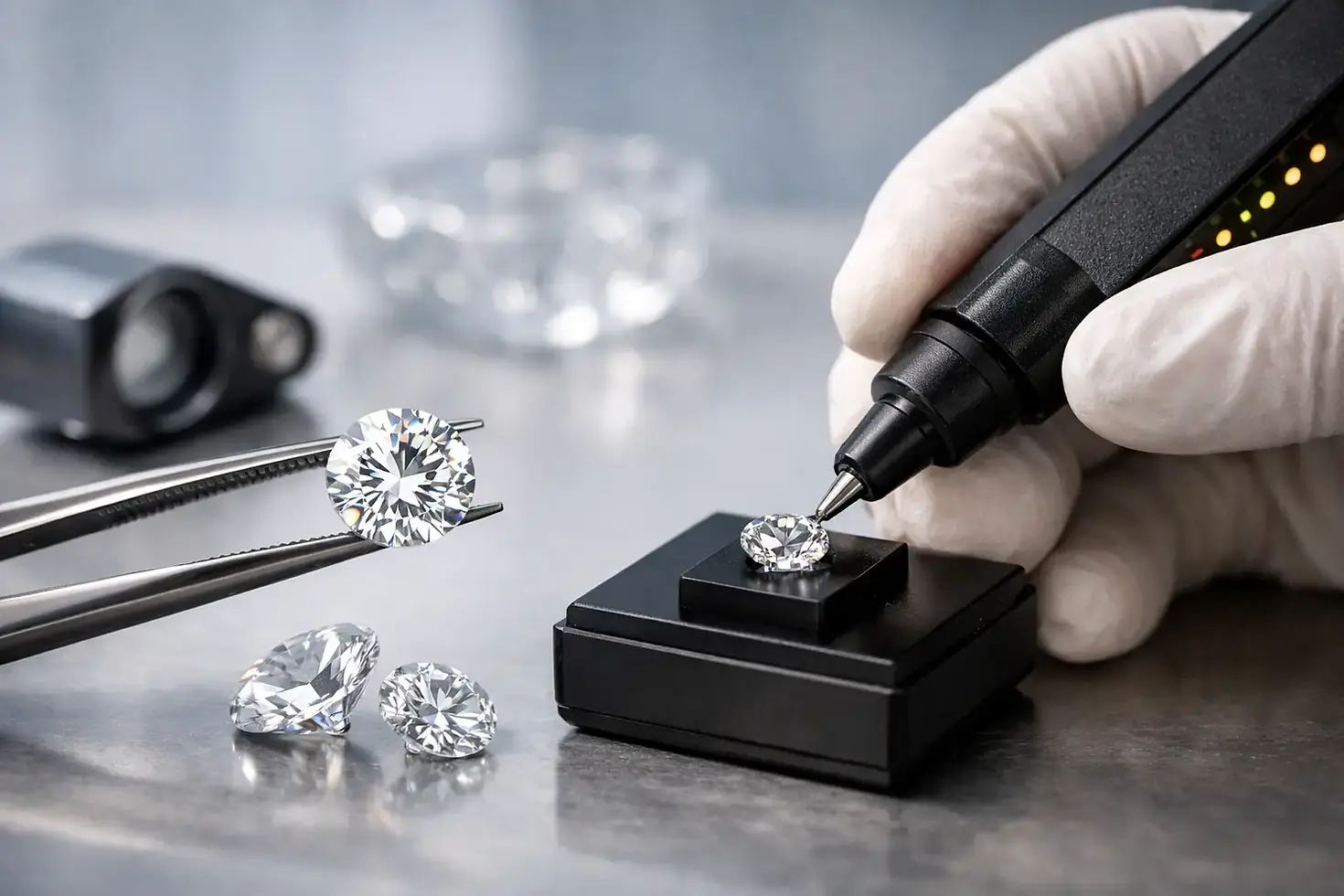
Most confusion starts with handheld diamond testers. Many of these tools check thermal conductivity, which is simply how quickly heat moves through a stone. Diamonds conduct heat very well, but moissanite also conducts heat efficiently enough that older or simpler testers can mistake one for the other.
This is where shoppers get tripped up. Lab grown diamonds and natural diamonds share the same core material structure - both are real diamonds made of crystallized carbon. So if a tester can identify natural diamond, it should also identify lab grown diamond. The problem is that not every tester is sophisticated enough to separate diamond from diamond simulants with precision.
Some devices only tell the user that the stone falls into a broad range consistent with diamond-like thermal behavior. If the jeweler assumes too much from that result, a lab grown diamond may be labeled moissanite, or a moissanite may be labeled diamond, depending on the machine and the conditions.
Lab grown diamond vs moissanite: why the mix-up happens
Lab grown diamonds and moissanite may look similar at a glance, but they are different materials. A lab grown diamond is chemically and optically a diamond. Moissanite is silicon carbide, which is a completely different gemstone.
The confusion comes from the fact that both are popular alternatives to mined diamonds in modern fine jewelry. Both are chosen for beauty, durability, and value. Both can appear colorless. And both can be set in high-end engagement rings, fashion rings, pendants, and earrings.
From a luxury buyer’s perspective, the difference matters because the stones perform differently in subtle ways. Moissanite often shows more rainbow flash, while diamonds tend to display a more balanced pattern of white light and colored sparkle. Lab grown diamonds also receive diamond grading standards, while moissanite is evaluated differently.
Still, visual differences are not always obvious in casual settings. Under store lighting, with a mounted stone and a fast test, mistakes happen more often than people expect.
How jewelry testers actually work
A basic thermal tester sends heat through the stone and reads how the material responds. This method is fast, affordable, and useful for initial screening. It is not always the final word.
More advanced testers use both thermal and electrical conductivity. That matters because moissanite and diamond behave differently electrically. A dual tester can often separate the two much more reliably than an older thermal-only device.
Even then, testing is not foolproof in every real-world situation. Dirt on the stone, metal touching the probe, a very small stone, loose settings, or a tester that has not been calibrated can all affect the result. Jewelry is rarely tested in a perfect lab environment when someone is standing at a counter waiting for an answer.
That is why professional gem identification usually goes beyond one beep from one handheld tool.
Older testers are a major reason for false readings
If a lab grown diamond tests as moissanite, one of the first things to consider is the age and quality of the tester. Older models were built at a time when the market had fewer lab grown diamonds and less need to distinguish among diamond, moissanite, and other simulants with precision.
Many of those tools were helpful for sorting obvious non-diamond stones from likely diamonds. They were never meant to replace gemological analysis. In a modern jewelry market where lab grown diamonds are widely used in fine jewelry, relying on outdated equipment creates room for misidentification.
Mounted stones are harder to test accurately
A loose stone is easier to evaluate than one already set in a ring. In a mounted setting, prongs and surrounding metal can interfere with the probe. The angle may be awkward. The center stone may also be close to side stones, which complicates a quick reading.
This is especially relevant for engagement rings with hidden halos, pavé bands, or intricate custom settings. Beautiful design can make simple testing more difficult, not because anything is wrong with the stone, but because the setting limits access.
Can a lab grown diamond ever truly be moissanite?
If a stone is a genuine lab grown diamond, then no - it is not moissanite. The two are different gemstones. A tester result does not change the identity of the stone.
What can happen, however, is mislabeling somewhere in the supply chain, particularly when buying from sellers with weak documentation or limited transparency. That is why certification and trusted sourcing matter. A properly graded lab grown diamond should come with clear identifying information from a recognized grading authority.
For buyers investing in fine jewelry, this is not just about technical accuracy. It is about confidence. When you are choosing a stone for a proposal, anniversary, or heirloom-quality piece, you want documentation that matches the craftsmanship and value of the design.
The best ways to verify a lab grown diamond
If there is any doubt, the strongest next step is independent verification through better testing and proper grading records. A reputable jeweler or gemologist will not rely on a single thermal reading if the result seems questionable.
They may examine the stone with magnification, review the grading report, and use specialized instruments that distinguish diamond from moissanite with much greater accuracy. Many lab grown diamonds also have laser inscriptions on the girdle that correspond to their certification number, which provides another layer of confirmation.
This is one reason educated buyers often prefer retailers that combine luxury presentation with transparent diamond education. It is easier to shop confidently when the process includes stone details, certification clarity, and access to expert guidance rather than guesswork.
Why proper identification matters when you are shopping
For some buyers, this question is about resale or insurance. For others, it is about making sure the stone matches the emotional and financial significance of the piece. Both reasons are valid.
Lab grown diamonds appeal to many modern shoppers because they offer real diamond beauty with a compelling value proposition. Moissanite appeals to others for its own reasons, including price and bold brilliance. Neither choice needs apology. But they are not interchangeable, and they should never be presented as if they are.
A polished shopping experience should make that distinction clear. Whether you are designing a bespoke engagement ring or selecting a ready-to-ship gift, the stone type should be accurately represented, properly documented, and confidently explained.
What to do if your stone tested as moissanite
Start by staying calm. One handheld result does not settle the issue. Ask what kind of tester was used and whether it measures thermal conductivity only or both thermal and electrical conductivity.
Next, request the stone’s grading report if one exists. If the stone is mounted, ask whether it can be evaluated more accurately by a gemologist using professional equipment. If you purchased from a quality-focused jeweler such as AV Luxury Gems, this is exactly the kind of question that should be met with clarity, service, and documentation rather than vague reassurance.
The right answer is not always instant, but it should be evidence-based.
A more confident way to buy
The better question is often not why do lab grown diamonds test as moissanite, but why so many shoppers are still expected to trust oversimplified testing in a category as meaningful as fine jewelry. When the purchase matters, precision matters too.
A beautiful stone deserves more than a quick guess across a countertop. Ask for certification, work with a jeweler who understands modern diamond options, and choose a piece backed by craftsmanship and transparency. That is how luxury should feel - elevated, personal, and certain.


Comments